What Order to File Taxes Again
Definition of Tax:
"Revenue enhancement is an obligatory contribution (Fiscal charge) from the Person (individual, company, business firm, and others) to the government to meet the expenses incurred in the common interest of Order."
"Tax is imposition fiscal charge which levied upon a taxpayer by Regime regime for do good of people in the country"
Basics of Tax
Taxation plays a prominent role in the economic development of any country. Taxation is a system through which government raises or collect revenue from Public. Governments use these revenues for the welfare of society in various forms similar paying salaries of soldiers and constabulary, Construction of dams and roads, to operate schools and hospitals, to provide food to the poor and besides medical services, and for other purposes. Without taxes, whatsoever government could not exist. Revenue enhancement tin redistribute a higher class society's wealth past imposing taxes on them in guild to maintain equality in society.
What exercise you sympathize past the term Revenue enhancement?
In simple words, It is the part of our income which the Government collects from us and provides several facilities like, h2o and drainage system, school facility, medical facilities, construction of roads and dams and so on. Revenue enhancement is a compulsory payment or contribution levied past the government authorization on individuals or companies to run into the expenditure which is required for the welfare of social club.
Characteristics of Taxation:
It is a compulsory contribution.
- It is a contribution for the benefit of lodge.
- It is a personal responsibility.
- A tax is paid out of the total income of the taxpayer.
- A taxation requires legal sanction.
Tax structure (Indian Perspective)
There are mainly ii directions of taxes
- Direct Taxation
- Indirect Tax
Straight Tax: "It is the revenue enhancement, which is paid straight by the public to the authorities"
"The revenue enhancement whose burden straight falls on the taxpayers or it is paid directly by a taxpayer to the corresponding say-so." Information technology cannot be shifted to others. E.chiliad. Income tax.
Indirect Tax: "It is the taxation, which is paid indirectly past people to the government."
The burdens of tax indirectly fall on the ultimate consumer are called equally Indirect Tax. E.g. Service Tax, These are the taxes that can't be seen by ultimate consumers.
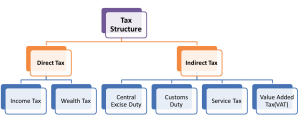
More often than not, Direct tax is once more divided into the following types:
a) Income tax- As the name suggests itself information technology is a tax on the full income of the taxpayer.
b) Wealth Tax- It is charged on the cyberspace wealth of the assessee
Generally, Indirect tax is again divided into the following types:
a) Key Excise Duty- Excise duty is levied on production or industry of goods.
b) Custom Duty- Custom duty is a duty which is levied past Fundamental Govt. on import of goods and export of goods from Bharat.
c) Service revenue enhancement- It is a tax levied on taxable services. generally, service provider pays tax and recovers from the consumer from the recipient of taxable service
d) Value Added Tax (VAT) – VAT is a revenue enhancement on the sale of goods inside the states only. information technology is a multi-stage revenue enhancement, Information technology is paid by the manufacturer, wholesaler, retailers and finally, it is on transferred on consumer
Difference betwixt Direct Tax and Indirect Taxation
| Basis | Directly Revenue enhancement | Indirect Tax |
| Definition | Direct Tax is paid directly by the public to the authorities | Indirect tax is paid indirectly by people to the regime |
| Burden of tax | The brunt of revenue enhancement cannot be shifted to others. | The burden of tax shifted to Ultimate consumer. |
| Tax Nerveless | subsequently the income for a year is earned | At the time of auction of purchases or rendering of services |
| Example | Income tax | Service revenue enhancement |
Basic terms in taxation
Assessee-
In simple words, assessee ways a Person past whom whatever tax or any other sum of money is payable is chosen assessee. E.thousand. Mr. Shyam is liable to pay income tax then he is assessee. Then any person who is liable to pay tax or any sum of money nether the Income Revenue enhancement Deed is called assessee.
Assessment year-
Cess year means the period of twelve months starting on 1st April every yr and catastrophe on 31st March of the next twelvemonth.E.yard. The assessment year 2014-15 will starts from 1st Apr 2014 then period of 12 months and information technology ends on 31st March 2015
Previous yr-
It is the financial yr immediately preceding the assessment year. In simply words, the year in which income is earned is known as the previous year. E.chiliad. If any persons earns income let's say 2012 this is the previous yr and it is taxable in adjacent year i.due east. A.Y. 2013
Income-
The definition of income includes profits and gains from business, whatever winnings from lotteries, crossword puzzles, races and other, income received from dividends, majuscule gain from transfer of capital assets, whatever voluntary contributions received by a trust or scientific research association.
Person-
The definition of a person is in an inclusive style.it includes-
- An Individual. e.thousand. Mr. Aakash
- HUF ( Hindu Undivided Family).
- Visitor. e.k. ABC Pvt. Ltd.
- Partnership firm. e.g. Thousand/South A and associates.
- An association of persons (AOP) or a Torso of Individuals (BOI).
- Local Dominance. due east.g. Municipal Corporation.
- Every Artificial Juridical person non falling inside any of the above categories. Pune University.
Gross Total Income –
Total of five heads i.east. aggregate of Income from Salaries, Income from Business firm Property, Profits and Gains from Business or Profession, income from Capital Gains, Income from Other Sources.
Total Income-
Gross total income less (minus) permissible deduction nether section 80 to 80 U.
Income taxation Slabs
The Income tax slab and rates applicable for the Financial Year (FY) 2013-xiv and Assessment Twelvemonth (AY) 2014-15 are mentioned below:
1. For Individual's and HUF (Hindu Undivided Family)
| Income (in Rupees) | Tax Per centum |
| 0 to 2,00,000 | No tax |
| 2,00,001 to five,00,000 | x% |
| v,00,001 to 10,00,000 | 20% |
| Above x,00,000 | 30% |
ii.Senior Denizen(Historic period 60-less than eighty)
| Income (in Rupees) | Tax Percentage |
| 0 to 2,50,000 | No revenue enhancement |
| two,00,001 to v,00,000 | ten% |
| 5,00,001 to 10,00,000 | twenty% |
| Above 10,00,000 | 30% |
3.Very Senior Citizen(Age fourscore and to a higher place)
| Income (in Rupees) | Revenue enhancement Percent |
| 0 to five,00,000 | No tax |
| five,00,001 to 10,00,000 | xx% |
| Above ten,00,000 | xxx% |
Taxation FAQ's
Who has to pay Income Tax?
A Person who'south earned Income in India, exceeds a prescribed limit or income slabs has to pay income tax
What happens if I don't pay the Income Tax?
Any people who will evade the payment of tax, penalty or interest levied under Income Revenue enhancement Act.
Who has to file the Income Tax Return?
Filing of Income Tax Return is compulsory if the taxable income exceeds the basic income taxation exemption limit.
How can I (salaried Employee) pay the Income Tax?
For Salaried Persons:
Income Taxation can be paid on the basis of Form 16 Certificate, which is issued by his employer which contains the details of the bacon received from the employer.
What are the diverse heads of Taxable Income?
In that location are Five Heads of Income
a. Income from Bacon
b. Income from House Property
c. Income from profits and gains of Business or Profession
d. Income from Majuscule gains
e. Income from Other Sources.
What is meant past Income tax Exemptions?
It means a reduction from the taxable amount on which tax will not be paid.
What is a PAN?
PAN (Permanent Account Number) is a unique alphanumeric combination issued by Income tax Authority.
Who has to demand to learn PAN?
Every person, who is liable to pay the revenue enhancement required to obtain Permanent Business relationship Number by making an application in form No 49A.
What is meant by TDS (Tax Deduction at Source) ?
TDS (Tax Deduction at Source) means the tax required to be paid past the Assessee, which is deducted by the person (please refer in a higher place definition) paying the income to him.
Source: https://www.educba.com/what-is-tax/
0 Response to "What Order to File Taxes Again"
Post a Comment